- Home
- about stbrigits
- Church Buildings As Assets
Simply Catholic and Welcoming You
Congregations Should See Their Church Buildings as Assets, not unwieldy expenses!
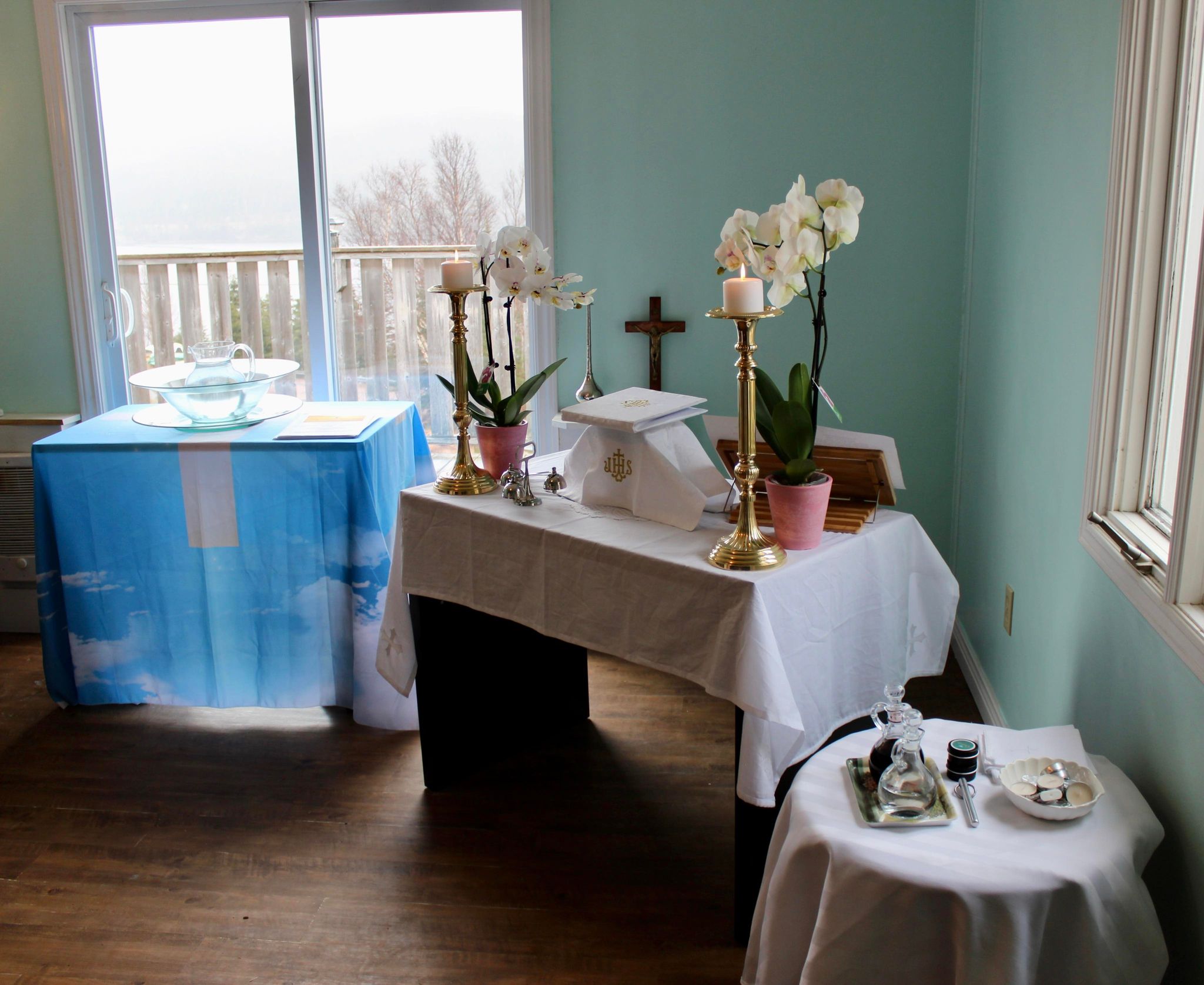
In a House Church - An Altar Flanked By a Baptismal Font and a Credence Table
Congregations should see their buildings as assets, not unwieldy expenses and, if a congregation is going to have a place out of which to do ministry and worship, then it’s got to have a building that’s connected to and appropriate for that purpose. And if a congregation is going to be planted in a community that it has relationships with, then ideally the building is serving a role in the community beyond that of just the congregation.
Always ask the question, “Who else shares your space?
“Who else has access?
What are you thinking about your signage?
What are you thinking about your neighbors who are adjacent to your property?”
Those are all signs and signals about the vitality and possibility for ministry of a congregation.
Buildings come with all kinds of anxiety, because often people don’t know what to do about them.
If you’re going to have a building, it’s got to be tied to the mission. And congregations then need to know what their mission is.
Large church buildings are a lot of work and they were built to do things that we no longer do and they were built to hold congregation sizes that we no longer have.
So how do we use them for the ways in which they can be an asset not just to us but to the rest of the community -- which is an ethic the church should have all along, right?
People have been worshiping online, but the ministry and presence has continued. That’s teaching us something we should be paying attention to.
Clearly, we don’t need the buildings to be a church community. We need to be able to gather, to participate in the sacraments, but we may not need to do it in the buildings we’ve historically done that in. And if the buildings are hampering our ability to do the ministry, then we need to ask some hard questions about that and confront the answers.
I’d rather have a small diocese in terms of numbers of congregations that are really clear about who they are, why they exist, what their call to walk with Christ is about and what their building can do to help support that mission than to have a lot churches half of which don’t know why they’re there and their building is just empty most of the week.
That’s not edifying God. Nor is it about our building being a congregational or a community hub. It is simply a sinful waste of valuable assets for any building to sit empty six days a week.
The mission we have as a diocese is to be beacons of Jesus Christ, to be inviting people to join us in the work of transformation, to stand with the marginalized and vulnerable and be working to transform systems of injustice and to be networking with anybody who will come along with that vision, people of faith or none.
That’s the work, and to be raising up leaders, lay and ordained, to do that.
When I get up in the morning, my question is -- after thanking God for a new day via Divine Office, Rosary and Holy Mass -- how are we doing that?
How does our building serve our mission? How do we make and keep it a community hub, seven days a week? What about youth groups and activities? Senior clubs? Community outreach? Mission outreach - yes they’re different and should be different? Can our church office operate out of the same building?
Church Buildings as Assets - St. Brigit's Community Catholic Church - The House Church Concept
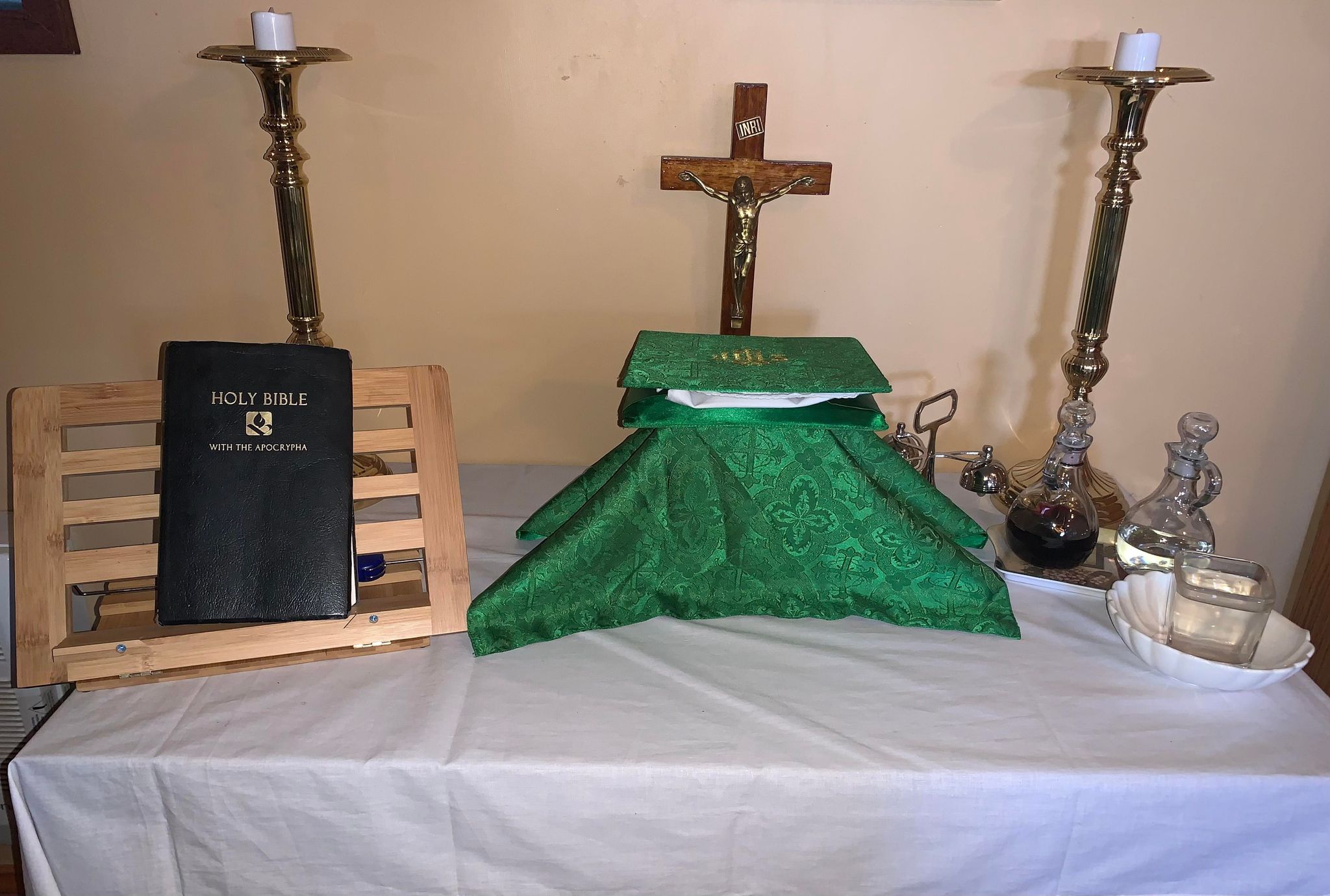
A Simple Altar in a House Church
In this day and age we don’t really need any building that exceeds the size of the average house. With adequate parking and zoning permission, many homes could easily serve as a church complete with offices, washrooms and handicapped access. So, why don’t we go that way? The answers lay in tradition and resistance to change.
Churches used to have massive congregations requiring large worship buildings with separate parish halls and separate church offices (these may or may not have been in the parochial/priests house).
These days most, especially rural congregations are in the 10 to 30 person range. Meaning that a converted home can and should serve as a worship center, community meeting hall and church offices (maybe even throw in serving lunches or other meals for seniors or needy community members regardless of them attending church or not).
If the community doesn't have the funds for a dedicated worship center, why not just rent the local community hall or school gym for the worship services. Community services, clubs, etc don’t need to be separated into church affiliations. Indeed I would argue that it is better that they are not.
People may not be as comfortable coming out to a church for lunch or dinner (fearing someone trying to convert them from their own choice of churches) as they should be simply coming to the community hall to get together with neighbours for that same meal!
If several churches worked together in this manner, pooling small shared resources instead of needing large financial backing, we could all better serve the community at large.
The only problem would be getting the same churches to share the praise for the work that is then done. No one group could claim that they did it all, as was the old church competitive mentality of “look what we did”.
Funny how Christ said that if we sought praise for our charitable works then we already had our rewards so we should give our alms in secret and build up our rewards in heaven. Huummp, did the churches miss that part or just get caught up in being the biggest show in town?
This would also keep the community resources/wealth distributed locally and to the general community rather than going out of the community into diosecean coffers. Oh, maybe that was the problem/goal in the original mindset.
At St. Brigit’s Community Catholic Church our vision is to be an integral part of each local community even as we establish and grow as a church. Not some totally separated “club” where people have to be a certain way to belong.
Simply being a part of the community bringing the Apostolic Priesthood of God to the people of God right where they live, work and play. All faiths together and separating only as individuals choose when it is time for actual formal worship. Yet worshiping together in community works and works of common service such that all may gain and fewer are left to suffer alone.
This is why we say we are a “House church”. For us worship, office and community centers should be one and the same. All contained in the 2,000 square foot normally taken up in an everyday home.
If we don’t have a dedicated ‘house of worship’ then all office work can be done from the cleric's home and everything else done from community spaces be they shared, rented or open use public areas.
When it appears that more space is required another church hub should be developed in another community or part of a larger community. More small, interpersonal church groups rather than one large group where most of the congregation remain invisible for most of their lives.
Ironic that the larger churches are trying to divest of their excess of buildings and get people to go to one larger center when it is clear that firstly this is not a successful concept and it is equally clear that people need to feel connected to their church personally and locally. Not merely attend some larger facility out of policy, expectation or demand by whatever church group they have thus far belonged to.
Smaller, personal church groups in every community is clearly the right way to go! People need to not only feel that they belong to a church but also that the church in real and practical ways “belongs” to them.
When the congregation grows, simply duplicate. We talk of being the “body of Christ”, well then follow the logic of the body which grows, rejuvenates and evolves through simple cell division. If 10 to 30 people is the current congregation limit/norm then when a specific congregation reaches 40 people split it into two 20 person groups and continue to grow both till they divide again.
Locate each new hub centrally to that group of people, most likely a group of related families so choosing a location will be natural for them.
House churches, small, interpersonal, connected and valued by local congregations who feel valued and connected in turn to their little church. Remember, people don't care what you feel until they feel that you care.
Larger churches have lost track of that basic premise and have, unfortunately, proven just how distant, disconnected and uncaring they truly are for local needs and feelings.
Christ did not teach us a system of beliefs. He showed us the Way of life. His Way was Love, close, personal, connected and absolutely caring. "By their Love shall ye know them." John 13:35
It's time to get back to being local, personal disciples of Christ. It's time to return to the house churches such we saw in the early New Testament. Such as the house of Priscilla and Aquila (Romans 16:5, 1 Corinthians 16:19), Philemon (Philemon 1:2), and Nympha (Colossians 4:15). These home-based gatherings were central to early Christian life for worship, fellowship, and breaking bread.
They worked then and they'll work now!
Recent Articles


-
The Divine Office
Aug 07, 26 01:16 PM
 The Divine Office The Divine Office, also known as the Liturgy of the Hours or Opus Dei ("Work of God"), is the official, daily set of prayers of the Catholic Church
 -
A Simplified Breviary
Aug 07, 26 01:14 PM
 A Simplified Breviary or Missal of The Divine Office of St. Brigit's Community Catholic Church.
 -
The Ethiopian Bible
Jul 25, 26 09:07 AM
 The Ethiopian Bible, compared to the Roman Catholic and Protestant Bibles gives us a totally different view of early Christian teachings and practices,


Boat Harbour West, Newfoundland, Canada. Cell Number 709-276-0626
Join Us Also on Our St. Brigit's Community Catholic Church Prayer group on Facebook: https://www.facebook.com/groups/324523956473448