- Home
- about stbrigits
- Authentic Religion
Simply Catholic and Welcoming You
Authentic Religion
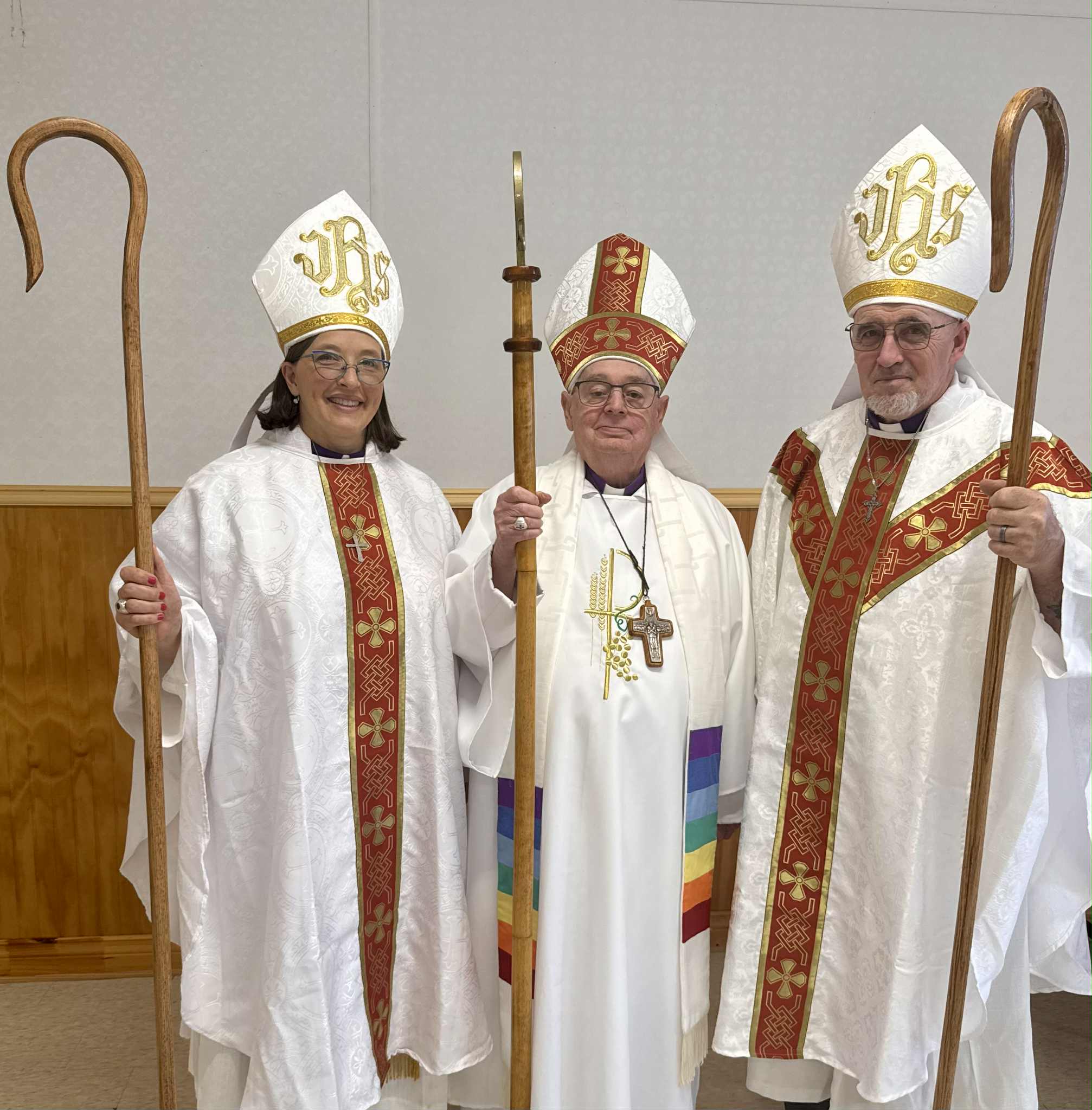
Archbishop Thomas Twose (center) flanked by Provincial Bishop Charlene Bradley left) and Archbishop Philip Bradley (right). To be Considered Authentic, Valid Catholics Requires Clergy to Have Full Apostolic Succession and Valid Priesthood Orders Which all Clergy With St. Brigit's Community Catholic Church Possess.
Authentic religion provides a holistic framework for human flourishing by balancing spirituality (inner connection with the divine), morality (ethical behavior toward others), and faith (belief and trust). When these pillars are disconnected, religious institutions often lose their constructive purpose.
Here is how these three core elements should interact to form a healthy spiritual community:
- Spirituality: The personal, transcendent experience that fosters inner peace, mindfulness, and a relationship with a higher power. It is the internal compass that drives an individual's desire for meaning.
- Morality: The practical application of spiritual values in daily life, emphasizing justice, compassion, honesty, and charity. Without moral action, faith becomes mere intellectual assent.”Faith without works is dead” (James 2:14)
- Faith: The foundational trust and commitment that anchors believers, providing hope and a shared framework for understanding existence.
When a community over-emphasizes one element to the exclusion of the others, it often leads to common institutional dysfunctions:
- Spirituality without Morality: Can lead to self-centered narcissism, where "enlightenment" is pursued at the expense of ethical obligations to others.
- Morality without Spirituality: Often devolves into rigid legalism, guilt, or mere social work, stripping away the transcendent joy and comfort that religion offers.
- Faith without Morality/Spirituality: Risks becoming empty dogmatism or fanaticism, where the adherence to rules replaces genuine love and inner transformation.
A friend posted this on their Facebook;
“𝖶𝗂𝗍𝗁 𝖲𝗉𝗂𝗋𝗂𝗍𝗎𝖺𝗅𝗂𝗍𝗒 𝖼𝗈𝗆𝖾𝗌 𝖬𝗈𝗋𝖺𝗅𝗂𝗍𝗒.
Morality is doing what is right, regardless of what you are told.
Religion is doing what you are told, regardless of what is right.'
True spirituality is not measured by the prayers you recite, the labels you carry, or the beliefs you defend.
It is measured by the kindness you show, the compassion you practice, and the way you treat others when no one is watching.
The highest form of faith is not found in words.
It is found in living with wisdom, integrity, and love.”
I wish I could say that they are wrong. Unfortunately they are not, neither are they completely accurate. The portion where they state their understanding of true spirituality I can heartily endorse.
“Religion is doing what you are told, regardless of what is right”?? That such posts/quotes resonate with so many people is a very sad statement of the state and or perception of too many world religions today. This seems a remarkable, sad reflection of the disconnect evident in too many “religions” today.
Many are indeed dogmatic, fanatical, ‘by the rules or you’re out’, often patriarchal clubs/cults whose focus appears to be only interested in producing more clones of what they believe to be the types of people who uniquely qualify for acceptance in their group and ultimate salvation.
For the moment let me leave the global scope of this discussion in terms of faiths other than Christian/Quasi Christian religions and or denominations and focus just on those. As a Catholic Archbishop, I think it incumbent upon me to speak most clearly to Christians generally and Catholics especially.
Jesus came that all mankind might be saved.
This declaration reflects the foundational Christian message of universal grace and divine love. Scripture emphasizes that God’s primary mission is to offer redemption and eternal life to everyone. No exceptions!
Core verses that highlight this purpose include:
- John 3:17: "For God did not send his Son into the world to condemn the world, but to save the world through him."
- 1 Timothy 2:4: States that God "desires all men to be saved and to come to the knowledge of the truth."
- 1 Timothy 1:15: Highlights that Christ Jesus came into the world to save sinners.
These next phrases from the New Testament, were famously written by the Apostle Paul to dismantle religious and social barriers. Signifying that all people—regardless of their ethnic, social, or gender backgrounds—are equal before God and united as one.
- Galatians 3:28: Paul writes, "There is neither Jew nor Greek, there is neither slave nor free, there is no male and female, for you are all one in Christ Jesus." (Some translations use "Gentile" instead of "Greek").
- Colossians 3:11: Paul emphasizes that in this new community "there is no Gentile or Jew, circumcised or uncircumcised, barbarian, Scythian, slave or free, but Christ is all, and is in all."
Key Interpretations
- Spiritual Equality: This means that no specific ethnic group has a higher spiritual standing than another. Everyone has equal access to salvation.
- Unity, Not Erasing Identity: The verse does not mean physical differences, cultural backgrounds, or genders literally cease to exist. Instead, it means these differences should no longer cause division, discrimination, or hierarchy within the community.
- Heirs to the Promise: Paul concludes these verses by stating that because everyone is "one," anyone who believes is considered part of the family and equally eligible for spiritual inheritance.
St. Brigit’s Community Catholic Church stance on Authentic Religion
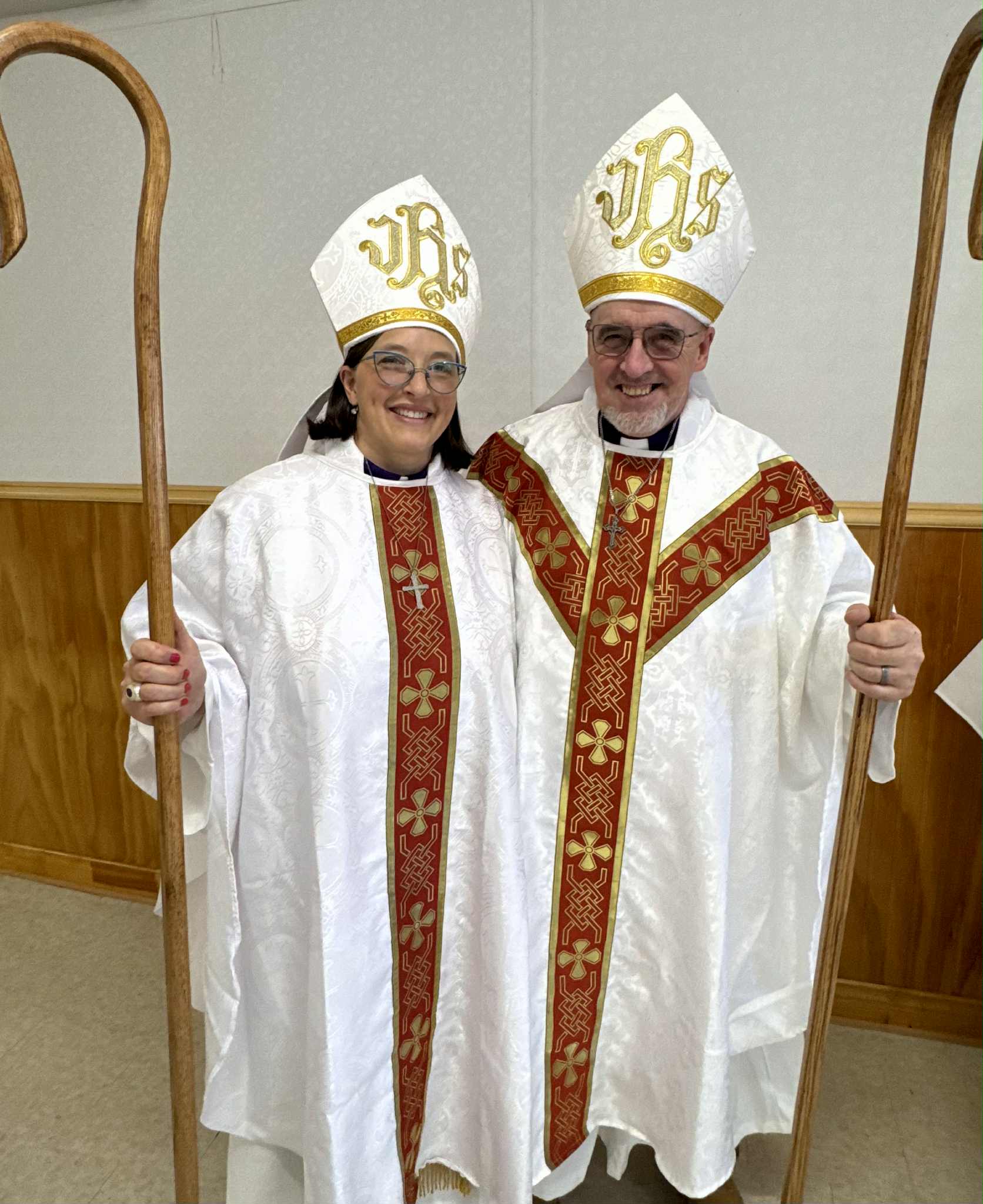
Husband and Wife Episcopate, Philip and Charlene Bradley Both Serve At St. Brigit's Community Catholic Church Where We Make No Distinctions Between a Persons Marital Status, Gender, Orientation Nor Any Other Aspect of Our Diverse Humanity Viewing All As Equal. All Are One In Christ Jesus.
St. Brigit’s Community Catholic Church stance on all of this is quite simple. We are too often criticized by other Christian churches, other Catholic churches/denominations included for being too liberal, too woke, too inclusive, too accepting. To those saying these things we say please read again what Jesus and Paul said should be our approach.
All are one, no barriers accepted, salvation is for ALL mankind. Our only exclusions are peoples self exclusion and those excluded by law from being where the young or other vulnerable persons congregate (those we will minister too privately since they too are to be offered salvation through Christ Jesus).
Jesus frequently and harshly criticized the Pharisees for hypocrisy, legalism, and misplaced priorities. He condemned their emphasis on rigid, outward religious rituals while neglecting justice, mercy, and genuine faith.
The New Testament provides profound insight into the specific reasons behind Jesus's critique of the religious leaders:
- Hypocrisy & Outward Show: Jesus compared the Pharisees to "whitewashed tombs"—appearing beautiful and righteous on the outside, but inwardly full of greed, self-indulgence, and spiritual deadness.
- Prioritizing Rules Over People: They burdened the common people with strict, complex man-made rules for observing the Sabbath and tithing. Specifically the Pharisees created exhaustive traditions (like a list of exactly 39 forbidden labors on the Sabbath). In Matthew 23:4, Jesus condemned this, saying: "They tie up heavy, cumbersome loads and put them on other people's shoulders, but they themselves are not willing to lift a finger to move them."
- Neglecting the "Weightier Matters": Jesus rebuked them for obsessively tithing tiny garden herbs (like mint and cumin) while completely ignoring the more important aspects of God's law: justice, mercy, and faithfulness.
- Pride & Virtue Signaling: They loved public recognition, seeking out the best seats in synagogues, wearing ostentatious religious clothing, and demanding respectful titles.
Jesus frequently criticized the Pharisees for their heavy focus on legalism—taking God's original laws and over-complicating them with thousands of man-made, burdensome rules.
Why He Objected
Instead of drawing people closer to God, these endless man-made rules acted as a barrier. Jesus valued grace, compassion, and human need over ritualistic observance, which often put him totally at odds with the religious leaders of his day.
Now, I ask you to look, truly look at so many of today’s Christian and Quasi Christian churches and denominations. Sadly His same rebuke would apply to most of them today as it did to the Pharisees and Sadducees in His day.
Let’s make no mistake, this is still His day! If there are rules to salvation they can only be His rules.
In Matthew 7:21 Jesus emphasizes that entrance into the kingdom of heaven requires action, not just words. This means that true salvation is demonstrated by actively following and carrying out God's will.
Throughout the scriptures, "doing the will of the Father" is consistently tied to specific teachings and actions:
- Believing in Jesus: In John 6:40, Jesus explicitly defines the Father's will: "For this is the will of My Father, that everyone who sees the Son and believes in Him may have everlasting life."
- Love and Obedience: True believers reflect their love for God through active obedience to His commands and by showing genuine love to others.
- True Discipleship: In Matthew 12:50, Jesus expands on this, stating that anyone who does the will of His Father is considered His spiritual family—His "brother and sister and mother".
This passage serves as a reminder that a relationship with God involves both faith and a transformed life. By definition then, it involves the union of Spirituality, Morality and Faith. No separation of these three can be acceptable!
Jesus taught us to have the simple, total faith of a child. Why then must we as individuals and as institutions insist on making faith, religion, morality or spirituality so damnably complicated!
Love God, Love our neighbour as ourselves and Judge not lest ye be judged. Jesus made it this simple and succinct. “All” we have to do is to live accordingly, simply, lovingly. Perhaps the real reason we make doing this so very difficult is to attempt to justify our failures to live as He calls us to live. If it’s ‘tough’ we have a built in excuse for failing. But what if it really is just that simple!
Recent Articles


-
The Divine Office
Aug 07, 26 01:16 PM
 The Divine Office The Divine Office, also known as the Liturgy of the Hours or Opus Dei ("Work of God"), is the official, daily set of prayers of the Catholic Church
 -
A Simplified Breviary
Aug 07, 26 01:14 PM
 A Simplified Breviary or Missal of The Divine Office of St. Brigit's Community Catholic Church.
 -
The Ethiopian Bible
Jul 25, 26 09:07 AM
 The Ethiopian Bible, compared to the Roman Catholic and Protestant Bibles gives us a totally different view of early Christian teachings and practices,

Boat Harbour West, Newfoundland, Canada. Cell Number 709-276-0626
Join Us Also on Our St. Brigit's Community Catholic Church Prayer group on Facebook: https://www.facebook.com/groups/324523956473448