- Home
- simply catholic
- Divine Office
Simply Catholic and Welcoming You
The Divine Office
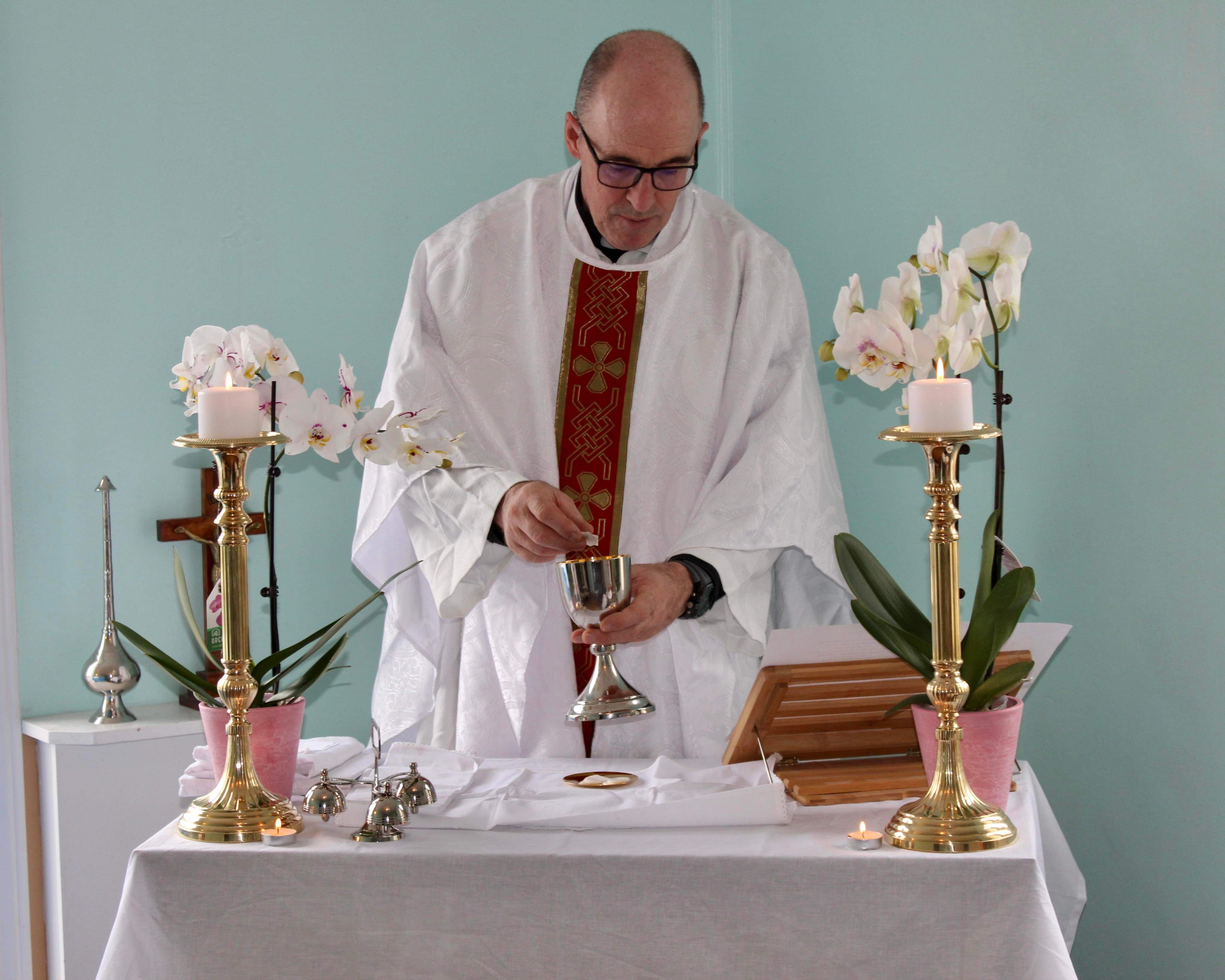
Archbishop Philip Bradley Confects the Holy Eucharist at Mass - We include Daily Mass as Part of Our Daily Divine Office
The Divine Office, also known as the Liturgy of the Hours or Opus Dei ("Work of God"), is the official, daily set of prayers of the Catholic Church meant to sanctify the day. It consists of psalms, hymns, scripture readings, and prayers, providing a structured way to pray throughout the day, rooted in Jewish tradition.
Key Aspects of the Divine Office:
- Purpose: The main aim is to mark the hours of the day and sanctify them with prayer, often described as fulfilling the commandment to "pray without ceasing".
- Structure: While it contains several "hours" (including the Office of Readings, Daytime Prayer), the core is centered on Morning Prayer (Lauds) and Evening Prayer (Vespers).
- Participants: While priests, deacons, and religious are obliged to pray it, the Church encourages laity to participate in this prayer as well.
- Content: It is composed heavily of the Psalms, along with readings from the Old and New Testaments, hymns, and prayers.
- "Breviary": The book containing the prayers is commonly referred to as a breviary.
The Divine Office is not merely private prayer; it is considered the public worship of the Church, uniting those who pray it with the Church’s universal prayer.
St. Benedict was very impressed by the symbolism of the number 7. So when Psalm 118 says: Seven times a day have I praised you - that’s how many times he wanted his monks to come together for prayer for the Offices of Lauds, Prime, Terce, Sext, None, Vespers and Compline.
Psalm 118 also says: "At night I rose to give you praise": so St. Benedict had his monks sing Vigils very early in the morning, before dawn.
The Psalms
So what about the Psalms?
There are plenty of problems with the Psalms. They come from a cultural milieu which is utterly different from our own. Often their sense is very obscure, sometimes simply incomprehensible. Above all, they remain resolutely Old Testament.
The teaching of Jesus in the Sermon on the Mount is absent. No turning of the other cheek for the Psalmist: he wants to see his enemies destroyed! His horizon too remains firmly fixed in this life, with almost no notion of any after life with or without God. Sometimes too he dwells on his own righteousness, and asks for it to be rewarded, in a way that seems to us sheer Pharisaism.
The experience of the ages confirms this. The Psalms speak to God, or cry out to God, with a refreshing directness and familiarity. They express every human emotion, just as it is, in the raw, from the heights of spiritual joy to the depths of anguish and despair, and with everything else in between. Jesus prayed the Psalms, so did his disciples, so did his mother, and so has the whole Church done throughout the ages.
You could boil human emotions down to two main categories: that of being Up, and that of being Down. Up Psalms sing out: Alleluia! Praise the Lord! Thank you Lord, for all your goodness, mercy and love! How wonderful it all is; how wonderful is this world you have made, and how wonderful is my life lived out amidst it all! Then the Down Psalms cry out: Lord have mercy on me, a miserable sinner! Lord save me from this mess I’m in! Lord, you surely see I can’t cope without your help! Come quickly then to my aid!
One of the greatest Christian commentators on the Psalms was St. Augustine. Believing very strongly in their divine inspiration, he thanked God for providing us with the words we need in order to praise him. Like most of the Church Fathers, he read Christ back into the Psalms, finding allegorical or accommodated meanings in their every detail.
So, for example, when the Psalmist speaks of his enemies, he taught that we should think not of people but of vices, or bad habits, or even demons. When he speaks of victory for the King we think of Christ’s resurrection from the dead. Etc.
One obvious justification for this method is St. Luke’s account of the risen Christ appearing to the gathered disciples on Easter Day. He explains to them how all that was written about him “in the Law of Moses and the Prophets and the Psalms had to be fulfilled” (Lk 24:44). Then Luke says, he opened their minds, so that they could understand the Scriptures.
The current Roman Catholic usage (post-Vatican II) consists of five main parts, with the option to include three others:
Main Hours (Liturgy of the Hours)
- Office of Readings (Latin: Officium lectionis): Formerly called Matins. It can be prayed at any time of the day.
- Morning Prayer (Latin: Lauds): Prayed at dawn to praise God at the beginning of the day.
- Daytime Prayer (Latin: Horae mediae): This can be one or all of three "Little Hours":
- Midmorning Prayer (Latin: Terce) – Traditionally 9:00 a.m.
- Midday Prayer (Latin: Sext) – Traditionally noon
- Midafternoon Prayer (Latin: None) – Traditionally 3:00 p.m.
- Evening Prayer (Latin: Vespers): Prayed at sunset as a sacrifice of praise.
- Night Prayer (Latin: Compline): Prayed before going to bed.
Additional Elements
- Invitatory: This is not an hour, but rather a preliminary psalm (usually Psalm 95) with an antiphon that introduces the very first office of the day, whether that is the Office of Readings or Morning Prayer.
Traditional/Monastic Hours (Pre-Vatican II/Benedictine)
Before reforms, the traditional structure included 8 hours:
- Matins (Midnight or early morning)
- Lauds (Dawn)
- Prime (First hour – approx. 6:00 a.m.)
- Terce (Third hour – approx. 9:00 a.m.)
- Sext (Sixth hour – noon)
- None (Ninth hour – approx. 3:00 p.m.)
- Vespers (Sunset)
- Compline (Bedtime)
Key Differences in Naming
- Matins is often replaced by Office of Readings.
- Lauds is Morning Prayer.
- Vespers is Evening Prayer.
- Compline is Night Prayer.
- Prime was suppressed in the modern Roman Rite, though it is still used in monastic communities and certain traditional Anglican uses.
The Divine Office and St. Brigit's Community Catholic Church
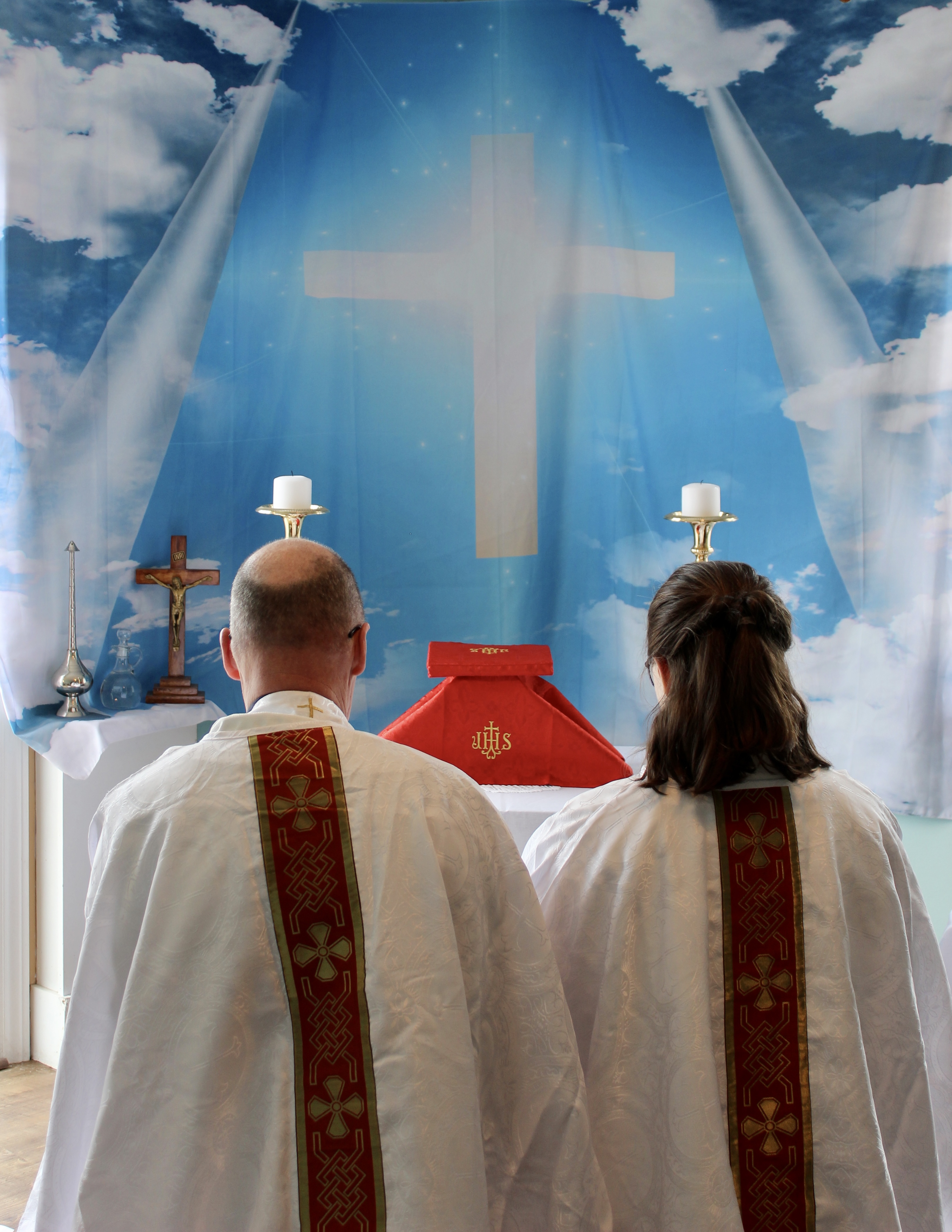
Archbishop Philip Bradley and Bishop Charlene Bradley Genuflect Before the Altar - Practicing "an Attitude of Prayer" Can Make All That We Do An Act of Prayer.
At St Brigit’s Community Catholic Church we do not see real sense in expecting most people to say these psalms daily AND have them understand, accept and apply the allegorical or accommodated meanings in their every detail as expressed by the Catholic and Anglican church fathers. We believe that most people will simply read what is actually written there, what the Jews of old actually meant in their “eye for an eye” world.
We uphold the Psalms and the rest of the Old Testament as valid scriptures from their times with meaningful lessons and messages for us even today yet they are primarily a record of the Jewish people’s dealings with God PRIOR to the coming of the promised Messiah.
In Matthew 5: 17-18, Jesus states he "came not to abolish the Law or the Prophets, but to fulfill them", meaning He completed the Old Testament's purpose by embodying its requirements, obeying its laws, and realizing its prophecies. He fulfilled them as a "doer" with a perfect life, a teacher revealing the true intent of the Law, and as the ultimate atoning sacrifice.
Key Aspects of Jesus Fulfilling the Law and Prophets:
- Definition of "Fulfill": It means "filling up" or bringing to completion/finality. Jesus brought out the full meaning of the Law, moving beyond mere external obedience to internal righteousness.
- Fulfilling the Law (Torah): Jesus perfectly obeyed the moral law and fulfilled the ceremonial laws through his sacrificial death, ending the need for continued animal sacrifices.
- Fulfilling the Prophets: Jesus accomplished hundreds of prophecies, embodying the promises of God and the hopes of Israel.
- The Entire Old Testament: "Law and Prophets" refers to the whole Hebrew Bible (including the Psalms).
- Not Abolished, but Completed: Jesus established the law's authority rather than discarding it. He fulfilled its purpose, meaning believers are now under the "law of Christ" rather than the old covenant law.
Essentially, Jesus demonstrated the true, deep purpose of the scriptures through his life, death, and resurrection, acting as the ultimate, intended conclusion of the Old Covenant and He gave us a new covenant to live by from His day forward.
The New Covenant, initiated by Jesus at the Last Supper through his sacrificial blood, fulfills the Old Covenant, replacing the law-based system with one of grace. It establishes a direct relationship with God, where the law is written on hearts, sins are forgiven, and believers receive an eternal inheritance.
Key Aspects of the New Covenant:
- Established in Blood: Jesus explicitly stated at the Last Supper, "This cup is the new covenant in my blood, which is poured out for you,".
- Replacement of the Old: It makes the Mosaic covenant (law) obsolete. The new arrangement is based on grace rather than legal obedience.
- Internalized Law: God's law is written in the hearts of believers, offering a personal, spiritual motivation for righteousness rather than external restriction. Christ initiates change from within through Love rather than the old system of rules and punishment.
- Direct Access: Christ’s ‘Way’ enables all people to know God directly, reducing the need for earthly mediators. This is a critical concept of true Catholic faith today.Yet most churches have firmly established themselves as the messenger and mediator between mankind and god, creating a system of dependency and control over believers.
- Forgiveness of Sins: The New Covenant is characterized by the complete forgiveness of sins. Christ did not come to judge or condemn but to bring salvation to ALL people.
- New Commandment: Jesus gave a new commandment to love one another just as he loves us ALL.
This covenant is often linked to the promise in Jeremiah 31:31-34, fulfilling the prophecy of a new, lasting relationship between God and humanity.
Why then is ‘the church’ still fixated on the psalms as their clergy required daily prayer/office? Why maintain the daily expression of the old law and the old ways? Tradition? Unwillingness to change?
Whatever the official reasons, we see only that “the emperor has no clothes” seems to apply here. In other words they have convinced themselves of the ‘wisdom’ of their own folly or worse, they have claimed the new covenant while still consciously sowing seeds of division and hate even within the churches outlook on non-church members.
In a world today filled with so called Christians who preach and or practice division, hate, personal and group superiority and other forms of exclusion we fear that the continued use of such words may predispose individuals and groups to act on the words of hate and revenge found and repeated daily in these psalms.
Christ preached love and acceptance of all people! We have chosen to match our daily prayers to the teachings of Christ rather than trying to convince people that what we say isn’t what those words actually mean to us.
Say what you mean and mean what you say was drilled into me when I was growing up. We believe that those words of advice are as valid today as they ever were. We believe this to be even more important in the context of church and faith.
We use and will continue to use readings from the Old Testament, Psalms and, of course, the New Testament in our daily practice of the Divine Office that are consistent with the message of Christ and His Divine Commission. All other readings we happily delegate to scripture studies where they can be understood in context of the times and people from and for whom they were written and their relevant meanings to us today.
Otherwise our words and our practice of our faith cause unnecessary questions and concerns for members and investigators alike. Having to ‘explain’ that ‘that isn’t really what we mean’, when we are clearly praying for harm upon our enemies, just will not cut it in this day and age.
Say what you mean. Mean what you say and actually live the Divine Commission of Christ. Ours is a God and a Redeemer of order and clarity. Daily recitation of prayers/office must accurately reflect our actual beliefs. No confusion. No chaos. Consistency!
We gladly adopt the concept of the Divine Office and choose to make it consistent with Our Savior’s message of Love, while also accepting that our clergy hold regular careers that can make following a formal “Office” difficult in many settings.
Christ advised that we pray in private (not meaning the exclusion of public/congregational prayers) so, for those for whom the practice of the formal Divine Office is both practical and their preference, we say great, go ahead. We still advise changing the readings to be consistent with the teachings of Christ and not attempting verbal and mental acrobatics by trying to change the meanings of existing readings. There are plenty of more suitable readings available for our use.
A simple path to follow is to:
- Say personal morning prayers with a suitable reading.
- Continue the practice of Lauds, Morning Prayers and
- Vespers, Evening Prayers (again with appropriate readings).
- We prefer to fit in a daily mass (home practice for those still working in other careers) at the start of our day or in the evening as best works.
- Say the Holy Rosary for the other “hours”.
- Finish our day with a reading and personal prayers, including an act of contrition for Compline/Night Prayers.
We also like to ‘fit in’ a Rosary, or other prayers, when we are traveling any distance or performing other time consuming yet relatively mundane tasks. We emphasize the goal of “pray without ceasing” rather than insisting on specific prayers, especially when busy lives make sitting with a breviary or headphones to do the formal prayers of the Divine Office simply not practical.
Remember that when we live in “an attitude of prayer”, everything we do becomes living prayers offering all that we do to the glory, honour and work of our god.
For further information and examples of a Simplified Breviary, a Missal of the Divine Office as prayed by the members of St. Brigit's Community Catholic Church, please see here.
Recent Articles


-
The Divine Office
Aug 07, 26 01:16 PM
 The Divine Office The Divine Office, also known as the Liturgy of the Hours or Opus Dei ("Work of God"), is the official, daily set of prayers of the Catholic Church
 -
A Simplified Breviary
Aug 07, 26 01:14 PM
 A Simplified Breviary or Missal of The Divine Office of St. Brigit's Community Catholic Church.
 -
The Ethiopian Bible
Jul 25, 26 09:07 AM
 The Ethiopian Bible, compared to the Roman Catholic and Protestant Bibles gives us a totally different view of early Christian teachings and practices,

Boat Harbour West, Newfoundland, Canada. Cell Number 709-276-0626
Join Us Also on Our St. Brigit's Community Catholic Church Prayer group on Facebook: https://www.facebook.com/groups/324523956473448