- Home
- simply catholic
- Basic Catechism
Simply Catholic and Welcoming You
The Basic Catechism of the Catholic Church

Bishop Charlene Bradley (Left), Archbishop Thomas Twose (Center) and Archbishop Philip Bradley (Right) - From Archbishop to the Newly Baptized We All Need to Know the Basic Teachings of our Faith as Contained in The Catechisms of Our Church
A basic catechism of any rite or branch of the catholic church acts as a primary reference for teaching the faith and is a study plan for children, youth and adult investigators of the catholic faith to enable them to understand the central themes of the faith. Each Catholic rite church has their own version of the catechism but each emphasizes the four primary study pillars of creed (faith professed), the sacraments (faith celebrated), life in Christ including the ten commandments (faith lived or morality) and Christian prayer especially the Lord’s Prayer (faith prayed).
The Catechism of the Catholic Church (C.C.C.), for Latin Rite/Roman Catholics, is a perfect example of such works and is an official, comprehensive summary of fundamental Catholic beliefs, doctrines, and morals promulgated by Pope John Paul II in 1992. It indeed serves as a central reference guide based on these same four main pillars.
Key Aspects of the that Catechism
- Structure: It is organized into 2,865 numbered paragraphs with extensive cross-referencing.
- Four Pillars:
- The Profession of Faith (Creed): What Catholics believe.
- The Celebration of the Christian Mystery (Sacraments): How Catholics worship.
- Life in Christ (Morality): How Catholics live, including the Ten Commandments and social teaching.
- Christian Prayer: How Catholics pray, focused on the Lord's Prayer.
- Purpose: It acts as a primary reference for teaching the faith and summarizes Catholic doctrine based on Scripture, tradition, and the lives of saints.
- Origins: While the current Catechism was issued in 1992, it continues the tradition of previous iterations, such as the Baltimore Catechism, which was last revised in 1941.
For a more concise or simplified version, Catholics often use the Compendium of the Catechism of the Catholic Church or the YOUCAT (Youth Catechism).
The Basic Catechism of the Catholic Church - Looking at the Options
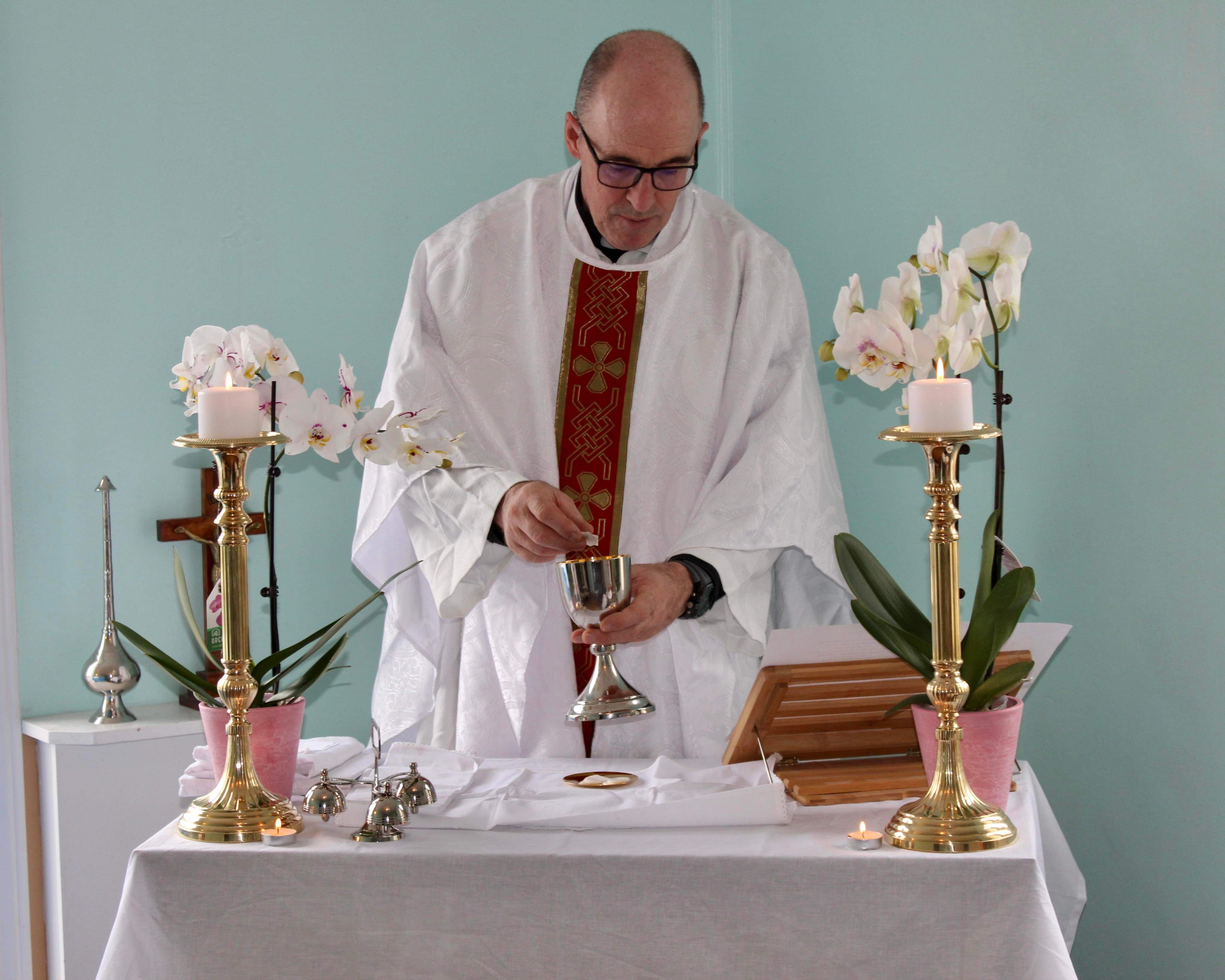
Archbishop Philip Bradley Confects the Holy Eucharist at Catholic Mass - Proper Understanding of The Basic Catechism of the Church is Essential in Order to Gain the Most From our Daily Practice of Our Faith
The Compendium of the Catechism of the Catholic Church
The Compendium is not a work that stands alone, nor is it intended in any way to replace the Catechism of the Catholic Church: instead, it refers constantly to the Catechism by means of reference numbers printed in the margins, as well as by consistent reliance on its structure, development and contents. In fact, the Compendium is meant to reawaken interest in and enthusiasm for the Catechism, which, in the wisdom of its presentation and the depth of its spirituality, always remains the basic text for catechesis in the Church today. Like the Catechism, the Compendium has four parts, corresponding to the fundamental laws of life in Christ
The YOUCAT, The Youth Catechism of the Catholic Church
YOUCAT, the Youth Catechism of the Catholic Church, is written in language suitable for young people and deals with the entire Catholic faith. The work is structured in Question-and-Answer format, and numbers after each answer refer the reader to the more extensive and in-depth treatments in the CCC.
The Baltimore Catechism
The Baltimore Catechism listed the following contents, which give a good insight into the types of study and study areas to be covered in a catechism:
Part One: The Creed
- The Purpose of Man's Existence
- God and His Perfections
- The Unity and Trinity of God
- Creation and the Angels
- The Creation and the Fall of Man
- Actual Sin
- The Incarnation
- The Redemption
- The Holy Ghost and Grace
- The Virtues and the Gifts of the Holy Ghost
- The Catholic Church
- The Marks and Attributes of the Church
- The Communion of Saints and Forgiveness of Sins
- The Resurrection and Life Everlasting
Part Two: The Commandments
- The Two Great Commandments
- The First Commandment of God
- Honoring the Saints, Relics, and Images
- The Second and Third Commandments of God
- The Fourth, Fifth, and Sixth Commandments of God
- The Seventh, Eighth, Ninth, and Tenth Commandments of God
- The Commandments of the Church; The First and Second Commandments
- The Third, Fourth, Fifth, and Sixth Commandments of the Church
Part Three: The Sacraments and Prayer
- The Sacraments
- Baptism
- Confirmation
- The Holy Eucharist
- The Sacrifice of the Mass
- Holy Communion
- Penance
- Contrition
- Confession
- How to Make a Good Confession
- Temporal Punishment and Indulgences
- Extreme Unction and Holy Orders
- Matrimony
- The Sacramentals
- Prayer
- The Our Father
As you can see, the Baltimore Catechism combined sacraments and prayers into one section but does still study/teach both pillars. The YOUCAT is written in language suitable for a younger readership. Both make constant references directly back to the Catechism of the Catholic Church.
Other Catholic rites of the church have similar works for studies, meaning a central publication and other versions for specific audiences. Often it is not the content that differs, just the emphasis or expression specific to the rite in question. After all, we remain “One, Holy, Catholic and Apostolic church”, despite, or maybe even because of our differences.
At St. Brigit’s Community Catholic Church we see no need nor purpose in reproducing these wonderful volumes of work on our common faith. Rather we simply teach from them as an expanded reference material and place emphasis, when needed or appropriate, on our specific expression of the Catholic faith. Acknowledging such things as our not being part of the Roman/Latin Rite of the church, not accepting papal supremacy, our being inclusive of race, gender and orientation differences in our congregation and clergy and our ordinations and consecrations of women and members of the L.G.B.T.Q.+ community to all stations within our clergy, welcoming all Christians to share the Eucharist and accepting baptisms done in any Christian church using the Triune formula.
At the end of the day we remain very aware of how harshly Jesus Himself criticized the Pharisees and Sadducees (Priests and scribes) in The Jewish faith for having so many rules and laws that they kept people from God, thus we are cautious of the extensive volume of the Catechism of the Catholic Church (rules - 2,865 numbered paragraphs) and the Canons of the Catholic Church (Laws - 1,752 canons).
At St. Brigit's Community Catholic Church we prefer to place our emphasis on a basic understanding of our faith through scripture study and the Apostle's and Nicene Creeds while holding to Christ's own words that "(He) I am the way the truth and the life". Thus the most critical part of Catholic faith is the development and maintenance of a deeply personal relationship with Christ Jesus and following His example in all things.
We endorse the K.I.S.S. principle of "what would Jesus say and do" along with following the promptings of the Holy Spirit. We fear that when people put "church teachings" ahead of what Christ Himself said and did then the Way of Christ can be too easily lost into the directives, way and will of man.
Referenced works:
Link to the Catechism of the Catholic Church;
https://www.vatican.va/archive/ENG0015/_INDEX.HTM
Link to the Baltimore Catechism;
https://www.catholicity.com/baltimore-catechism/lesson01.html
Link to YOUCAT;
Link to the Compendium of the Catechism of the Catholic Church;
https://www.vatican.va/archive/compendium_ccc/documents/archive_2005_compendium-ccc_en.html
Recent Articles


-
The Divine Office
Aug 07, 26 01:16 PM
 The Divine Office The Divine Office, also known as the Liturgy of the Hours or Opus Dei ("Work of God"), is the official, daily set of prayers of the Catholic Church
 -
A Simplified Breviary
Aug 07, 26 01:14 PM
 A Simplified Breviary or Missal of The Divine Office of St. Brigit's Community Catholic Church.
 -
The Ethiopian Bible
Jul 25, 26 09:07 AM
 The Ethiopian Bible, compared to the Roman Catholic and Protestant Bibles gives us a totally different view of early Christian teachings and practices,

Boat Harbour West, Newfoundland, Canada. Cell Number 709-276-0626
Join Us Also on Our St. Brigit's Community Catholic Church Prayer group on Facebook: https://www.facebook.com/groups/324523956473448