- Home
- about stbrigits
- Versions of The Lord’s Prayer
Simply Catholic and Welcoming You
Versions of The Lord’s Prayer
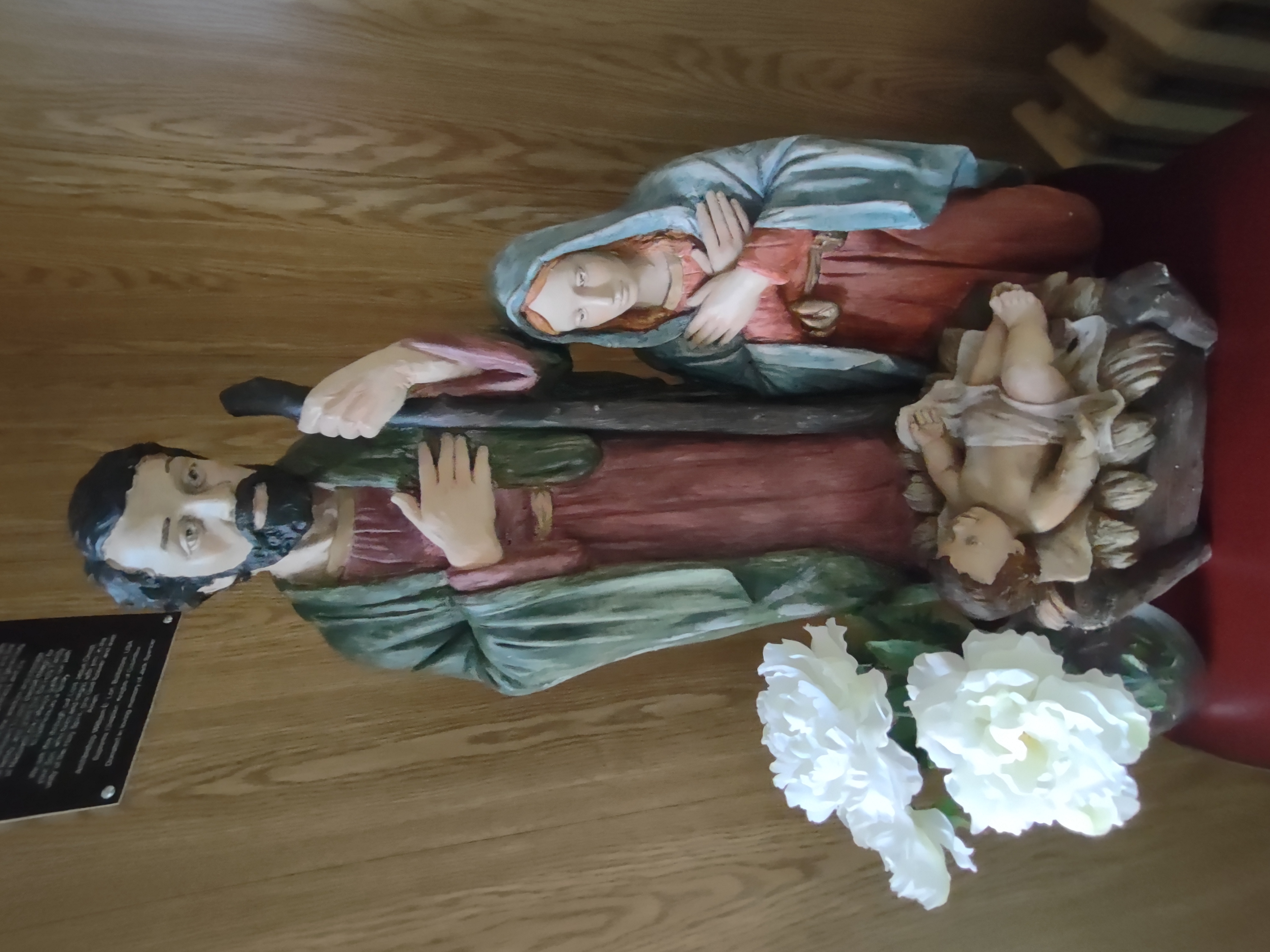
Statuary of the Holy Family - Joseph Was a Father to Jesus, Yet Jesus was The Only Begotten Son of Our Heavenly Father - a Perfect Example That We Are Born Into This World Yet, Like Him, Are Not Of This World For We Belong to The Kingdom of God
There are several versions of the Lord’s Prayer commonly circulated between various Christian denominations. Here I will explore some of these and present our version as well as explaining why ours is a little different from other western rites.
The Didache (Chapter 8) contains a version of the Lord's Prayer that is nearly identical to the Matthew 6:9–13 text, structured for early liturgical use by instructing Christians to pray it three times a day. The text is: "Our Father who art in heaven, hallowed be Your name. Your kingdom come. Your will be done, as in heaven, so on earth. Give us today our daily (needful) bread, and forgive us our debt as we also forgive our debtors. And bring us not into temptation, but deliver us from the evil one; for Yours is the power and the glory forever".
Two versions of this prayer are recorded in the gospels: a longer form within the Sermon on the Mount in the Gospel of Matthew 6.9–13, and a shorter form in the Gospel of Luke 11.1–4 when "one of his disciples said to him, 'Lord, teach us to pray, as John taught his disciples’.
Both versions do not include the ending sentence found in the Protestant version, “For thine is the Kingdom, the power, and the glory now and forever.” The “For thine…” is technically termed a doxology.
In the Bible, we find the practice of concluding prayers with a short, hymn-like verse which exalts the glory of God.
As history unfolded, some bibles added the doxology to Matthew's Lord's prayer. Others did not. Families of Christians learned the prayer in different ways. During the Second Vatican Council in the 1960s, Roman Catholics added the doxology to the communion rite but separated it by means of the embolism.
Key Aspects of the Didache Version:
- Context: It is introduced as the prayer commanded by the Lord in his Gospel, to be used in contrast to the prayers of "hypocrites".
- Doxology: It includes a short, early form of the doxology ("for Yours is the power and the glory forever").
- Textual Similarities: It aligns closely with Matthew's version, including the address "Our Father who art in heaven" and the phrase "Your will be done, as in heaven, so on earth".
- Usage: It commands the prayer to be said "Thrice in the day".
The text is generally considered an early, slightly altered liturgical adaptation of the Matthean version, rather than a separate independent source.
The first three of the seven petitions in Matthew address God; the other four are related to human needs and concerns. Matthew's account alone includes the "Your will be done" and the "Rescue us from the evil one" (or "Deliver us from evil") petitions.
Protestants usually conclude the prayer with a doxology (in some versions, "For thine is the kingdom, the power and the glory, for ever and ever, Amen"), a later addition appearing in some manuscripts of Matthew.
The Eastern Orthodox version is: “For Thine is the kingdom, and the power, and the glory: of the Father, and of the Son, and of the Holy Spirit, now and ever, and unto the ages of ages. Amen”.
The Matthean version is the one most common in general Christian usage.
The Catholic Latin liturgical rites have never attached the doxology to the end of the Lord's Prayer. The doxology does appear in the Roman /Latin Rite Mass as revised in 1969. After the conclusion of the Lord's Prayer, the priest says a prayer known as the embolism.
In the official International Commission on English in the Liturgy (ICEL) English translation, the embolism reads: "Deliver us, Lord, we pray, from every evil, graciously grant peace in our days, that, by the help of your mercy, we may be always free from sin and safe from all distress, as we await the blessed hope and the coming of our Saviour, Jesus Christ." This elaborates on the final petition, "Deliver us from evil." The people then respond to this with the doxology: "For the kingdom, the power, and the glory are yours, now and forever."
Pope Francis has upset some of the traditionalists by approving a change to the wording of the Lord’s Prayer . Instead of saying “lead us not into temptation…”, it will say “do not let us fall into temptation”. The new wording was approved by the general assembly of the Episcopal Conference of Italy in May of 2019.
Versions of The Lord’s Prayer - St. Brigit's Community Catholic Church Take on it all.
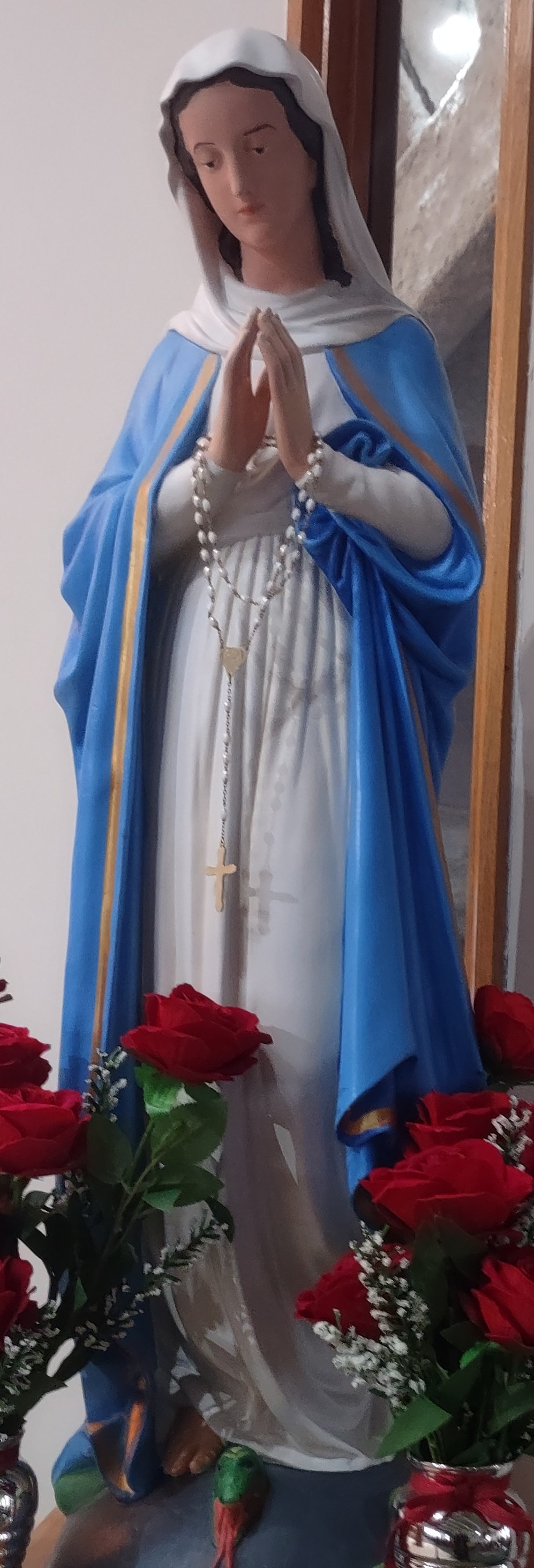
A Statue of he Blessed Virgin Mary - Mother of Jesus Who Is The Only Begotten Son of Our Heavenly Father -We must Be Careful Not to Identify As Being Of This World For We Have Our Origins Before We were Born Here; Ephesians 1:4 (NIV): "For he chose us in him before the creation of the world to be holy and blameless in his sight."
From time to time you may see versions of the Lord’s Prayer that have “declarative statements” before the Amen. These versions are not ‘approved’ by many mainstream churches as they do not appear in modern translations of the bible.
These declarative closings were, however, normal in old Jewish prayers especially during the High Holy Days, particularly leading up to and during Yom Kippur (the Day of Atonement). At these times "G'mar Chatima Tova" was a traditional Jewish greeting used during these High Holy Days and the declarative closings became known as ‘Chatimah’.
The concept of chatimah (meaning "sealing" or "final signature") in Jewish tradition, particularly regarding the High Holidays and Yom Kippur, refers to the finalization of divine judgment, a belief that solidified during the Second Temple period and in the early Rabbinic (Talmudic) era but was in clear evidence in the time of Christ Jesus.
During the time of Christ it would have been normal Jewish practice to end formal prayers with a ‘Chatimah’ , a declarative seal. Thus any teaching prayer and certainly any prayer following an ascending sequence would have closed with such a seal. Why then isn’t this the case with the Lord’s Prayer?
In essence, chatimah marks the final, solemn moment of judgment, encouraging intense introspection and prayer, with the "seal" representing the final verdict.
The Lord’s Prayer is a beautiful study in a teaching prayer that follows an ascending sequence in its seven petitions. In its ascension sequence it follows earth to heaven, material to spiritual, human need to divine alignment, debt to forgiveness, protection …….then stops. Incomplete!
Jesus, or any teaching rabbi of His day would not stop there. They would seal the prayer and then close it.
The Chatimah ended every formal prayer in the Jewish liturgical prayers of the Second Temple Tradition. The seal confirmed the prayer's completion and established its effect - alignment with God/Heavenly Father. These seals were declarations of ontological freedom. A declaration of origin. Of the very right to BE and not be bound by context or circumstances.
Ontological freedom refers to the fundamental, existential liberty of being—the capacity of a person to define their own essence, meaning, and purpose, rather than having it predetermined. It represents a foundational freedom to exist and act, often contrasting with, or preceding, ethical or legal restrictions.
Unlike political freedom (freedom from interference) or free will (freedom to choose), ontological freedom is about the freedom to be.
Studies such as the 2020 University of Toronto’s study of Identity Anchoring Declarations show that such declarations (seals) activate the medial prefrontal cortex disrupting “contextual capture” of the brain state - the brain state where our current environment determines our emotional responses.
They documented a 58% reduction in contextual capture within 60 seconds of such definitive declarations!
In Eastern Orthodox traditions (church rites) they use what they call the Apophatic Seal in formal prayers/liturgies. They close with a declarative statement stripping contextual identity and claiming only the most essential nature. Now, since we were all the one church to begin with and remain all part of the “One, Holy, Catholic and Apostolic Church today”, where do you suppose they got that? Likely from our common Jewish origins.
So were such declarations taken out of the western rites of the church as part of the overall sanitization of the faith to produce a global, safe and controlled organizational membership or innocently lost over time and translations? I won’t even attempt to actually open that debate.
That Jesus was an observant, practicing Jew, competent in both scriptural and Torah knowledge is well documented. His Lord’s Prayer follows, indeed perfects, the form of teaching prayer Rabbis of His day would have used. Yet we are to believe He didn’t finish this prayer in a manner consistent with His tradition or what His disciples would have expected as the natural ‘signal’ that the prayer was complete?
Without being flippant, I won’t truly know until I get to ask Him. Until then I will follow the Eastern Orthodox practice of the Apophatic Seal at the end of my personal prayers. We offer services for Latin/Roman and Anglican Rite congregations and will follow their formats for their gatherings, especially at Mass and Rosaries.
For my personal prayers and for ‘purely’ St. Brigit’s Community Catholic Church services we will add “declarative statements”, “identity anchoring declarations”, “Apophatic Seals” or whatever title anyone else knows these, “statements of origin” as.
We will use statements such as ;
“I am not what the world calls me, I am what was before this world named me.”
Or
“I am not of this realm and this realm has no claim on what I am.”
So, an example of ‘our’ Lord’s Prayer would be;
"Our Father, who art in heaven, hallowed be thy name;
thy kingdom come; thy will be done on earth as it is in heaven.
Give us this day our daily bread;
and forgive us our trespasses as we forgive those who trespass against us;
and let us not enter into temptation, but deliver us from evil.
For I am not what this world calls me.
I am what was before this world named me.
In the name of the Father, and of the Son, and of the Holy Spirit,
Amen".
Recent Articles


-
The Divine Office
Aug 07, 26 01:16 PM
 The Divine Office The Divine Office, also known as the Liturgy of the Hours or Opus Dei ("Work of God"), is the official, daily set of prayers of the Catholic Church
 -
A Simplified Breviary
Aug 07, 26 01:14 PM
 A Simplified Breviary or Missal of The Divine Office of St. Brigit's Community Catholic Church.
 -
The Ethiopian Bible
Jul 25, 26 09:07 AM
 The Ethiopian Bible, compared to the Roman Catholic and Protestant Bibles gives us a totally different view of early Christian teachings and practices,

Boat Harbour West, Newfoundland, Canada. Cell Number 709-276-0626
Join Us Also on Our St. Brigit's Community Catholic Church Prayer group on Facebook: https://www.facebook.com/groups/324523956473448